MakerLabs honours its 1,000th user
 26.04.2022 -
A place where inventors and hobbyists meet, exchange ideas and, above all, experiment – this is the MakerLabs, which have already been used by numerous participants to turn their ideas into initial prototypes. Tony Winkler, supervisor of the ‘FabLab’, recently welcomed the 1,000th MakerLab user.
Tim Maihold was delighted to receive the honour and the congratulations from those present. Leading the way, Prof. Jens Strackeljan, President of the University of Magdeburg, took the opportunity to offer his personal congratulations and to highlight the importance of the MakerLabs for the start-up culture at the OVGU.
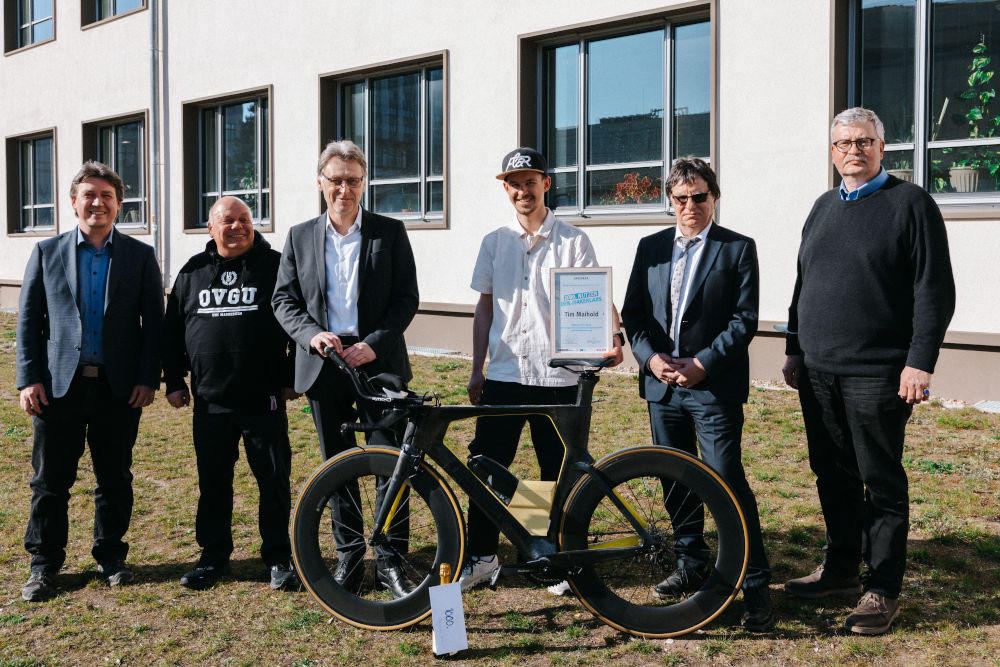
(from left: Tony Winkler, Dr Ingo Böhlert, Prof. Jens Strackeljan, Tim Maihold, Prof. Rüdiger Bähr, Dr Ingolf Behm / Photo: Hannah Theile/OVGU)
The Transfer and Start-Up Center (TUGZ) at the University of Magdeburg was delighted with the large number of users and the many creative and innovative projects that have emerged from them: “Tim Maihold’s work in the FabLab shows that the trusting collaboration between the MakerLabs and the TUGZ leads to sustainable results. Both the number of users in the incubators and the resulting technology-oriented start-ups have increased significantly, particularly in recent years. An ecosystem has emerged that, with further supporting measures, has the potential to grow beyond its current scope.”
The FabLab was opened back in April 2011 at the Institute of Manufacturing Technology and Quality Management (IFQ) within the Faculty of Mechanical Engineering. Since then, many more prototype and start-up workshops have been added. Currently, students and research staff can find 8 different MakerLabs spread across the campus, all supervised by expert staff.
We wanted to find out more about what Tim Maihold actually does at the FabLab, so we spoke to him.
Brief introduction: Who are you and what are you studying?
I’m Tim Maihold, a cyclist, bike and aero fitter, coach and aspiring product developer on the Master’s in Integrated Design Engineering since October 2021. Before that, I studied Sport and Technology at OVGU.
What exactly did you develop in the FabLab and how did you come up with the idea?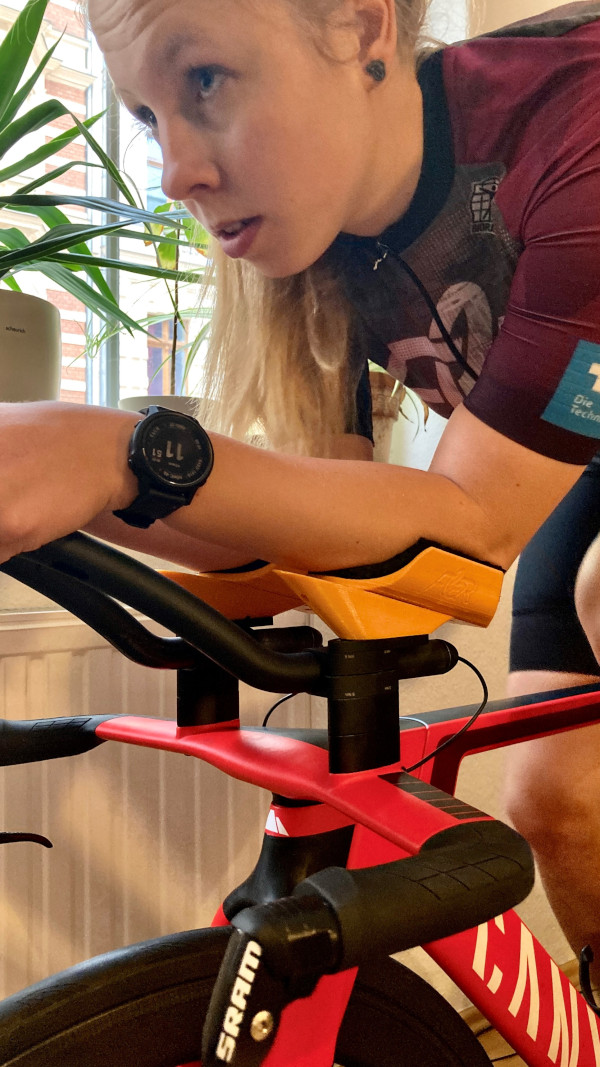
At the FabLab, I built part of a near-production prototype for a cockpit system used by triathletes and time trialists. I worked as a bike fitter in Berlin for 1.5 years and, during that time, wrote my Bachelor’s thesis on aerodynamics in cycling. In doing so, I realised how important comfort and stability are in aerodynamic cycling positions, whether for beginners or professionals. At the same time, bike manufacturers usually fit very poor cockpit systems as standard.
(Photo of the cockpit: the orange parts are 3D-printed prototypes; the lower section was built from aluminium in the FabLab.)
How was your supervisor Tony Winkler able to support you with this?
Without Tony, I would have been pretty much lost. I’d never seen a band saw or a CNC milling machine before, and I didn’t know how to turn my 3D model into a stable prototype. His expertise and his ideas on how to take the design through to the prototype stage helped me enormously. He was very committed and even recommended local companies for series production.
How did your project turn into a start-up opportunity?
Actually, I already spun off my project last autumn with an aerodynamic storage box for time trial bikes. In my view, it was the simplest way to put the idea into practice straight away. Of course, this involves a high level of risk, which, in my experience in the private sector, is unfortunately taken less often when employed. That’s why I see the start-up option as an opportunity for further development and professional experience.
Why are initiatives like the MakerLabs or the Transfer and Start-Up Center at the university important?
Precisely for this reason. When students have innovative ideas that bring added value to society or a part of it, they should be given the opportunity to put their ideas into practice without having to rely on their employer or tough investors. Low barriers and an easy entry – this can only be beneficial for a successful start-up culture in Saxony-Anhalt and beyond.
What other start-up support services did you use?
I was delighted to make use of the advisory services at TUGZ with Franziska Bartels. Thanks to her experience, she was always able to answer my questions about the start-up process and thus give me a second perspective on things. This allowed me to reflect on whether I was on the right track and hadn’t forgotten anything important. Some TUGZ workshops and seminars, for example on marketing and empowerment/networking, were also very informative.
What are your plans regarding your self-employment?
The next steps are to obtain manufacturing quotes, produce the product, and build a partner network and a marketing strategy to raise the product’s profile within the cycling community. At the same time, further product ideas are already in the pipeline.
I hope to gain further knowledge and tools from my studies that I can apply directly. If all goes well, I’ll be able to make a living from it once I’ve finished my Master’s. If not, at least I’ll have developed the product, made a few people happy and gained a wealth of experience. My dream would be to create a kind of think tank for cycling, where young people can work in synergistic teams to turn their ideas for improving services or products into projects and bring them to market.
The MakerLabs at Otto von Guericke University Magdeburg are ego.-INKUBATOREN funded by the State of Saxony-Anhalt and can be used free of charge under certain conditions.
In the prototyping and start-up workshops, students and research assistants from a university or recognised research institution in the state of Saxony-Anhalt can gain practical experience with technology, processes and organisational procedures, as well as develop their own ideas through to the launch of a start-up.
Further information is available at https://www.tugz.ovgu.de/makerlabs.html.